Saturday, 28 December 2019

NVR Vs. DVR – What’s the Difference?


Education Series from Global e solutions
When shopping for a security system, you’ll need to choose between a DVR or NVR recorder. Both perform the same function but differ in how and the type of cameras used. Understanding the difference between DVR and NVR is essential when evaluating security systems. In this article, our security experts will break down the differences and detail the pros and cons of each so that you can make an informed decision.
NVR vs. DVR – The Basics
At the core, both NVR and DVRs are responsible for video recording. DVR stands for Digital Video Recorder, whereas NVR stands for Network Video Recorder. The difference between NVR and DVR is how they process video data. DVR systems process the video data at the recorder, whereas NVR systems encode and process the video data at the camera, then stream it to the NVR recorder which is used for storage and remote viewing. As DVRs and NVRs handle the video data differently, they require different types of cameras. Most NVRs are used with IP cameras whereas DVRs are used with analog cameras. It’s important to note that a DVR based system is a wired security system, whereas NVR systems can be a wired or a wireless system.
DVR Security System – Pros & Cons
Advances in analog high definition within the last five years have reduced the gap in resolution between the two systems. You’ll probably notice that DVR based security systems are priced lower than NVR systems. The lower price point is an attractive advantage of DVR systems, but what are the trade-offs? To answer this, we need to break down each of the components of a DVR system.
Camera Type – Analog
The cameras used by a DVR system must be analog security cameras, better known as CCTV cameras. Most of the cost savings found by using a DVR system is due to the camera. While you can mix and match cameras in your home security system, there is less flexibility in the type of cameras you can use with DVR systems.
In a DVR system, the analog cameras stream an analog signal to the recorder, which then processes the images. The advantage of this system is the reduced complexity required of the camera when compared to an NVR system.
Cable – Coaxial BNC Cable
The camera connects to the DVR recorder via a coaxial BNC cable. Although the use of coaxial cable may not seem significant, it does have some limitations:
·         As the coaxial cable doesn’t provide power to the camera, there are actually two cables included within one covering – a power and video cable. The cables separate each end to provide the separate functions. As such, you’ll need to install your DVR recorder near a power outlet.
·         The size and rigidity of coaxial cables can make installation more challenging. The coaxial cable is wider in diameter than Ethernet cables used with NVR systems which can make it more difficult to run cables in tight spaces. Coaxial cables also tend to be more rigid, compounding this problem.
·         However, if your property has existing coaxial connections for a previous security system, you can use the same cable to connect your new system.
·         Standard coax cables do not support audio. A variant that with an added RCA connection is needed but even with these a DVR has a limited number of audio input ports so only a small number of cameras can record audio.
·         The image quality on the coaxial cable will begin to degrade after about 300ft/90m, which can limit the ability to which you will extend your security presence outward. The lower quality cable will result in a signal loss at shorter distances.
Recorder
DVR recorders rely on a hardware chipset known as an AD encoder, which is responsible for processing the raw data streaming from the camera into legible video recordings. DVR systems also have different requirements when it comes to the recorder. Specifically, in a DVR system, the user must connect every camera directly to the recorder. In comparison, an NVR system only requires that each camera connects to the same network. Also, in a DVR system, the recorder doesn’t provide power to the cameras. Each camera connection will need a splitter that supplies power to enable cameras to function.
System Flexibility
DVR security systems are less flexible than their NVR counterparts in terms of camera type and mounting options. Whereas NVR based systems can integrate both wired and wireless security cameras, DVR systems can only use wired security cameras. DVR systems also have less flexible mounting solutions, because routing coaxial cable can be more difficult in tight situations and a power outlet is required for each camera.
Image & Audio Quality
As we’ve discussed, in DVR systems the cameras transmit analog video via the coax cable directly to the recorder and images are processed at the recorder level. The analog signal results in a lower quality image compared to NVR systems. Coaxial cables also don’t natively transmit an audio signal, and DVR recorders usually have a limited number of audio input ports.
NVR Security System – Pros & Cons
NVR security camera systems incorporate the newest technology to provide an enhanced, feature-rich security system. Also known as POE security camera systems, NVR based systems are more flexible and complex than DVR systems.
Camera Type – IP Camera

As NVR systems process the video data at the camera rather than on the recorder, the cameras in NVR systems are much more robust than their DVR counterparts. NVR systems use 
IP cameras which are standalone image capturing devices. IP cameras each have a chipset that is capable of processing the video data which is then transmitted to a recorder. Unlike analog cameras, IP cameras are typically all capable of recording and sending audio as well as video. The more powerful hardware on IP cameras also enables improved smart functionality and video analytics, such as facial recognition.
Cable – Ethernet

Like DVR systems, NVR systems connect the camera to the recorder. However, how they connect the camera to the recorder is entirely different. NVR systems use standard Ethernet cables, such as cat5e and cat6, to transmit data. Professional installers prefer ethernet cables due to the number of advantages compared to coaxial cables:
·         Ethernet cable powers the camera using Power over Ethernet (PoE), which means your camera needs one cable running to capture video, audio, and power the camera, thus eliminating the need for messy splitters like a DVR system.
·         Ethernet cable tends to be easier to route and terminate because it is thinner and has a smaller connector allowing for less drilling.
·         Ethernet is cheaper than coaxial cable and much more readily available, making cable replacement or system the expansion more accessible and affordable. Many modern homes and businesses are being built wired for Ethernet, making installation even easier.
·         An added advantage of Ethernet cable is that every camera on the system can transmit audio since Ethernet can send audio data natively.
·         Cables do not need to run between every camera and the recorder. They need to be on the same wireless network. Installation is more straightforward and cleaner as multiple cables aren’t required.
·         Despite a shorter max Ethernet cable length, 328ft or 100m, network switches can be used to extend the total distance without impacting image quality.
Recorder
Unlike a DVR system, the recorder in an NVR system doesn’t process video data. That step is completed at the camera before it is transmitted. NVR recorders are only used for storing and viewing the footage.
System Flexibility

NVR systems are inherently more flexible because security cameras don’t necessarily have to be physically connected directly to the recorder. Instead, IP cameras only have to be on the same network. As such, you could feasibly have cameras all over the world on the same network that connect to your NVR can then be viewed as a comprehensive system.
Image & Audio Quality
As NVR recorders receive a pure digital signal from the cameras, video quality is better than compared to a DVR at the same resolution. In addition, as Ethernet cables carry audio, all cameras with microphones could record audio to the NVR.
In Summary – DVR vs. NVR System
Both systems record video data and are reliable. Although in the past the video quality of DVR systems lagged behind comparable NVR systems, today this gap is significantly lessened. The difference between DVR and NVR systems come down to the cost, how the data is transmitted, and the type of cameras. NVR systems tend to have better picture quality, as well as easier installation, increased flexibility, and native support for audio on every camera that has a microphone. However, NVR systems also tend to be quite a bit more expensive than comparable DVR systems, which is an important consideration for the budget-conscious consumer. For people looking for a relatively straightforward security system, a DVR system will most likely be sufficient, especially if your property is already wired for a coaxial cable from an existing security system. If you need a top of the line, very flexible solution, an NVR based system will be best. At the end of the day, the deciding factor will be based on the specific security needs of your property.
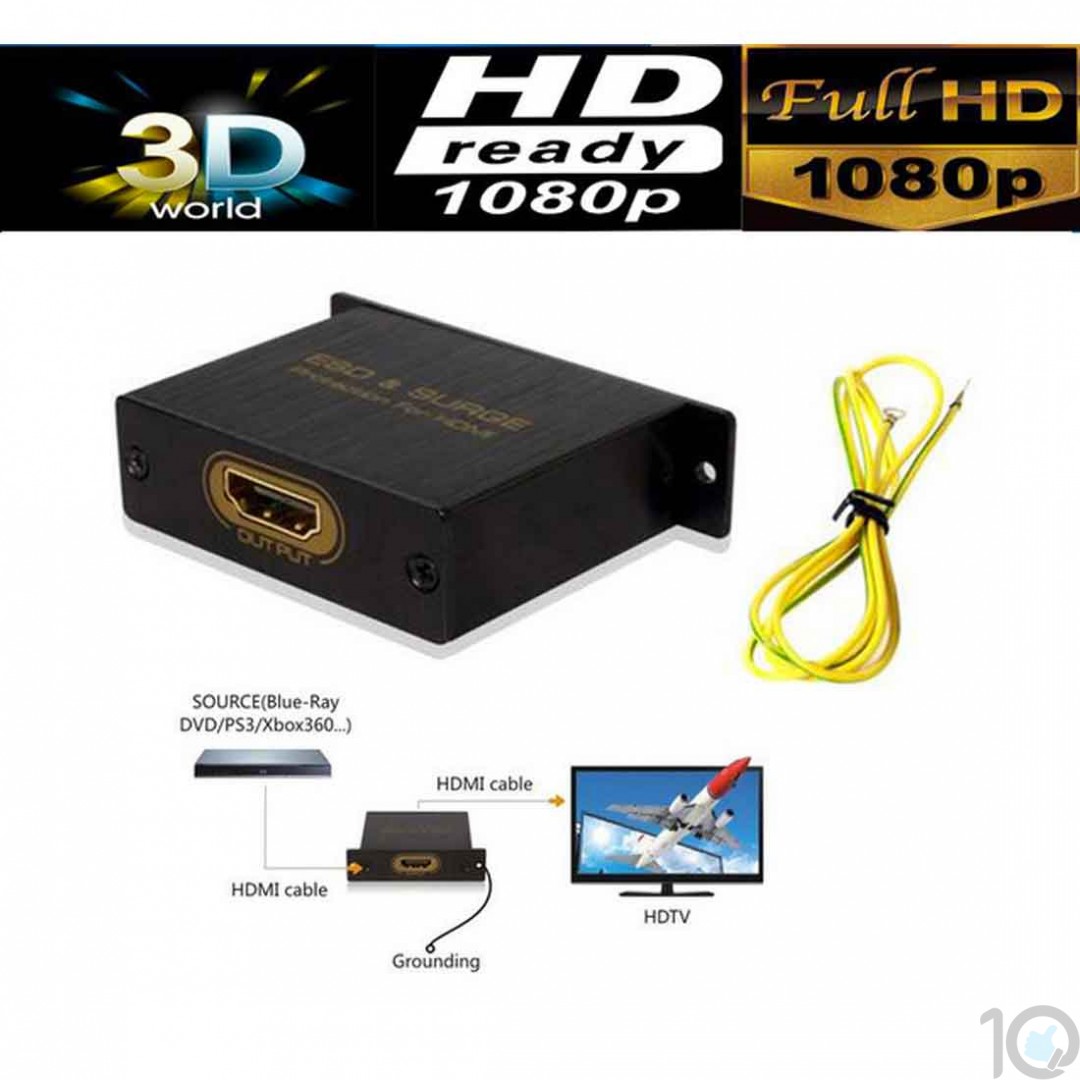
The HDMI surge protector is designed to protecting the HDMI device against the static discharge, lighting surge, electrical fast transient burst. It is all active at all TMDS/DDC/HPD and CEC channels of connected HDMI signals and it can do final defense for ESD and Lightning Surge.


Features:
1. Protect HDMI input and output for ESD and Lightning Surge
2. Meet IEC 61000-4-2 (ESD) ±15kV (air), ±8kV (contact).
3. Meet IEC 61000-4-4 (EFT) 40A (5/50ns).
4. Meet IEC 61000-4-5 (Lightning) 5A (8/20µs).
5. Support HDMI 1.4 with 3D, 4K2K and HEAC.
6. Solid-state silicon-avalanche technology.
7. Support HDCP
8. No loss of quality
9. Installs in minutes
10. No Need Power Adaptor

· #1 CCTV & Security Camera Installation Company
· Global e-Solutions
http://cctvcamera.webnode.com
https://www.linkedin.com/in/global123/
http://www.facebook.com/GlobalESolutions
https://globalesolutions.site123.me
Cell : +919048803007, +919846179999, 9961602200
Skype: globale123
WhatsApp:00919846179999

Friday, 27 December 2019


Face Identification System to monitor your Time-Attendance with Access restriction

Time Attendance System Sdk School Class Face Recognition Touch Screen Wifi Wireless Tablet. High-Precision Face Recognition Manufacturer for Attendance Systems, Support Customization. 3D Living Detection. 24 Hour Customer Service. Fast Recognition

A facial recognition system is a technology capable of identifying or verifying a person from a digital image or a video frame from a video source.

Attendance system companies in cochin | Biometric attendance system companies in cochin | Fingerprint attendance system companies in cochin

· #1 CCTV & Security Camera Installation Company
· Global e-Solutions
http://cctvcamera.webnode.com
https://www.linkedin.com/in/global123/
http://www.facebook.com/GlobalESolutions
https://globalesolutions.site123.me
Cell : +919048803007, +919846179999, 9961602200
Skype: globale123
WhatsApp:00919846179999

വെറും 3599/- രൂപക്ക്‌ ഒരു BEST CCTV ക്യാമറ. Mobile View.
Waterproof Outdoor Wi-Fi Camera Colour Night Vision
കൂടുതൽ അറിയാൻ WhatsApp or e mail to us
9846179999
Global e-Solutions ERNAKULAM
Global e-Solutions
http://cctvcamera.webnode.com
https://www.linkedin.com/in/global123/
http://www.facebook.com/GlobalESolutions
https://globalesolutions.site123.me
E-Mail :( Sales & Communications):- Global123@gmail.com
Cell : +919048803007, +919846179999, 9961602200
Skype: globale123
WhatsApp:00919846179999

Wednesday, 27 November 2019

Global e Solutions on of the pioneer in CCTV dealers Kochi, Ernakulam has deal in all kinds of CCTV cameras such as dome CCTV cameras, ANPR and LPR cameras, Bullet cameras, PTZ pan tilt and zoom CCTV cameras, Varifocal CCTV cameras and so on. We Provided CCTV installation services to their clients at the best prices. And having more than 7200 Installation as on credit from 2001 onwards.
✓CCTV Installation Services, ✓CCTV AMC, ✓CCTV Dealers-CP Plus, ✓CCTV Dealers-Hikvision, ✓Honeywell CCTV Dealers in Kochi, Ernakulam.
Fire Alarm, Boom Barrier, Security Alarm System, CCTV Camera & Video Door Phone Installation/ Retail & Wholesale Trader offered by
Global e Solutions from Aluva, Kalamassery, Thrippunithura, Ernakulam, Kerala, India.
Home security systems in Kerala, office and home CCTV dealers in Kochi for door security alarm suppliers and shops Thrissur, Kottayam
Call Now.
Global e-Solutions
http://cctvcamera.webnode.com
https://www.linkedin.com/in/global123/
http://www.facebook.com/GlobalESolutions
https://globalesolutions.site123.me
E-Mail  Sales & Communications):- Global123@gmail.com
Cell : +919048803007, +919846179999, 9961602200
Skype: globale123
WhatsApp:00919846179999

Monday, 18 November 2019

Tenda C80 1080P SMART HOME SECURITY IP Camera


Tenda C80 1080P SMART HOME SECURITY IP Camera
HD PTZ Wireless
Day/Night Cloud Camera

* 360° horizontal panorama * 1080P Video
* Two-Way Audio * Night Vision
* Motion alarm * Cloud Storage

Home security in high definition
Tenda C80 HD video gives you a clear view of what's going on at home. See more of your faces and
places - it's home security with an eye for detail.
Motion Detection & Notification/Image Push
When detecting motions, the camera automatically triggers alert and takes a snapshot.
Notification Push: the information of the alert can be pushed to you on the phone as soon as the
alert is triggered.
Image Push: the snapshot of the alert can be sent to your phone so that you can see the details.
SD/TF Card Storage and Cloud storage Service
The recorded video can be stored in the SD/TF card, which can be plugged in the external TF card
slot. C80 allows a maximum of 128GB TF card storage. And a 128GB card can save the video for
about 400 hours.

Global e-Solutions
http://cctvcamera.webnode.com
https://www.linkedin.com/in/global123/
http://www.facebook.com/GlobalESolutions
https://globalesolutions.site123.me
E-Mail :( Sales & Communications):- Global123@gmail.com
Cell : +919048803007, +919846179999, 9961602200
Skype: globale123
WhatsApp:00919846179999


Thursday, 10 October 2019


Artificial Intelligence 

(Artificial intelligence for video surveillance utilizes computer software programs that analyze the audio and images from video surveillance cameras in order to recognize humans, vehicles, objects and events.)
Today, there are in-depth discussions about what ‘might be’ possible with AI, machine and deep learning-based analytics products on the market. Much of the conversation centres on practical ways to utilize deep learning and neural networks and how these techniques can improve analytics and significantly reduce false-positives for important events. When talking to end users about analytics, it becomes clear that many still don’t take full advantage of analytics. In some cases, this can be due to a history of false-positives with previous generation technology, but in others, it can simply be a case of not believing that reliable analytics are achievable for their unique needs. The good news is that with AI, or more accurately, deep learning and neural networks, we are making great strides towards increasing accuracy.


In the past, developers tried to define what an object is, what motion is and what should be considered an interesting motion that we want to track versus false positive “noise” that should be ignored. Some classic examples are wind blowing leaves on a tree, rain, snow or a plastic bag floating by. For far too long, something as simple as motion detection has been plagued by false-positives generated by wind. Users could try and reduce the sensitivity, and eliminate the false motion in a light breeze and still see false positives with motion events triggered in a wind storm. Using neural networks and deep learning to define objects such as humans, cars, buses and animals means that traditional analytics can now focus on objects. These new algorithms have been taught to recognize a human being by seeing thousands of images of humans. Once an algorithm has learned these examples, it can apply this advanced knowledge to existing analytics. For example, if a car crossed a line at an entry gate it might be acceptable. However, if a person passes that same line, we might want an alert. A shadow should be ignored and swaying tree branches shouldn’t be considered. A car driving in the wrong direction warrants an alert, however people moving about freely is fine. All of the traditional analytics regarding motion such as appear / disappear, line crossing, object left behind and loitering will be more accurate and capable of additional refinement using AI and the power of object recognition.
Practical Applications and Limits for Security and Surveillance
Machine and deep learning-based analytics are actively being marketed and productized by many vendors with Hanwha Techwin poised to deliver its first AI-based cameras this year. Existing data models can be purchased from third party companies, but the question remains: How accurate are they? Additionally, many of these new AI-based analytics are offered as ‘post processes’ run on a server or workstation, when a majority of customer use cases demand real-time feedback.
It takes a significant amount of computational power for a machine to “self-learn” in the field, so “controlled learning” is best left to powerful server farms in R&D laboratories and universities for now. Real-time analytics also require that video streams be uncompressed to be analysed. While this might make sense for installations with a few cameras connected to a server, it’s clearly an unacceptable resource drain to decode (open) each compressed camera stream when hundreds of cameras are involved. Once an algorithm and data set are created, it can be ‘packed up’ and embedded on the edge to perform real-time detection and alerts for the specific conditions it has been trained to recognize. It will not self-learn, but it can provide a useful function for recognizing known objects or behaviours with minimum errors.
Having deep learning analytics on the edge —analysing the image before it is compressed and sent to storage— is clearly what everyone has in mind when they imagine the usefulness of such technology to alert staff and make decisions in real time.
Value Proposition of Deep Learning-based Analytics
The more we automate video processing and decision making, the more we can save operators from redundant and mundane tasks. Computers capable of sophisticated analysis, self-learning and basic decision making are much better and faster at analysing large volumes of data while humans are best utilized where advanced intelligence, situational analysis and dynamic interactions are required. Increased value comes from the efficiencies gained when each resource is used most effectively. The goal is to help operators make better-informed judgements by providing detailed input and descriptive metadata. A primary focus for AI in cameras today is to reduce, if not eliminate, false positives in existing analytics. Powerful object recognition allows us to completely remove common noise events caused by wind, rain and snow. AI-based cameras can precisely recognize objects such as vehicles and people, as well as capture identifying characteristics such as colours (up to two per object), carried items such as bags, backpacks, hats and glasses and even approximate gender and age. With object recognition, we can make existing analytics much more powerful—send an alert when a car crosses a line, while allowing humans to cross with no alert. By capturing additional descriptive metadata, AI-enabled cameras will make a forensic search within supported VMS more powerful than ever before.
We see airport security, subways and other mass transit customers as early adopters of this technology. Detecting objects left behind is crucial in the world we live in today. The benefits to retail organizations wanting to optimize their business operations is equally important. It may even be possible to rank reaction to products based on learned postures and skeletal movements as the technology continues to evolve. AI-based cameras enable systems integrators to sell value far beyond a security system. Integrations with other systems, even customer relationship management (CRM) systems will be not only possible, but desirable as a way to enhance metrics for retail establishments.
What to Expect in the Near Term?
Beyond enhanced accuracy of existing analytics, solutions for the near future might feature hybrid approaches where on-the-edge hardware combines with server software to deliver a powerful combination of analysis and early warning and detection capabilities. Comprehensive facial recognition and comparisons with large databases will not be practical on the edge anytime soon, so that is a good example of where servers can do some heavy lifting. Object recognition and classification is perfectly suited for in-camera analytics—the camera knows it is a face and can pass that metadata directly to a server which can further interpret the unique characteristics and cross reference with database entries. We can easily imagine that AI-based analytics might take the same progression as traditional analytics. The first implementations were server-based, then there was a migration to a hybrid approach where some algorithms were in the camera, but a server was still required for in-depth analysis, and ultimately the entire analytic process could be hosted on the edge.
The Future Looks Bright for Image Classification
Being able to identify what’s going on in a still or moving image is one of the most interesting areas of development in machine and deep learning. With moving images, analysis goes beyond simply classifying objects, to classifying the behaviours and moods of those in the frame. Already, vendors are talking about ‘aggression detection’ as a desirable feature, but it’s easy to imagine that the cost to an organization of a false positive or false negative in such a scenario could be very high. For that reason, Hanwha is taking a conservative approach as it develops its own algorithms in-house with teams of experts.
Whether it’s big players like Facebook, Google, or Nvidia, significant investments are being made in AI and machine learning to classify images and objects as well as text and speech. Some of this technology development will trickle down into the security industry, and much of it will have to be custom developed to suit the needs of surveillance workflows. It may be ok to mis-label a person’s face in Facebook, but security organizations should not be willing to make such a mistake. This is one of many reasons why our industry must insist on higher standards.

Customer expectations for AI and all its variants are understandably high. However, careful consideration is needed when choosing any AI type solution.

Thanks to Security Today and Hanwha Techwin, our R&D department.